
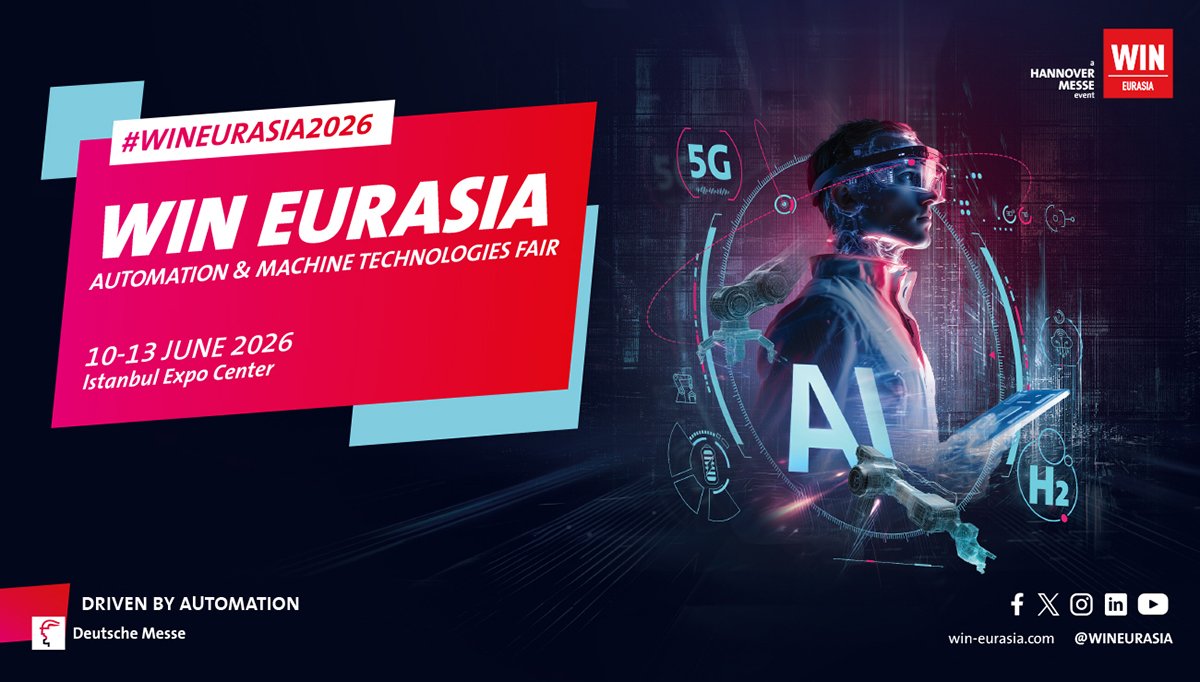
WIN EURASIA Automation and Machine Technologies Trade Fair has launched its preparations for 2026 with the motto “Driven by Automation.” WIN EURASIA, which has led the transformation of manufacturing and industry in Türkiye for 31 years and is organized by Hannover Fairs Turkey, will focus in its 2026 edition on electric, electronics transmission and distribution & energy automation, welding, joining, cutting, surface treatment technologies, compressor and compressed air technologies, as well as Internet of Things, 5G, and artificial intelligence integrations. The trade fair, which shapes the future of the manufacturing industry, will be held in six halls across a total area of 55,000 m².
WIN EURASIA will be held for the 32nd time between 10–13 June 2026 at the Istanbul Expo Center. Organized by Hannover Fairs Turkey with the motto “Driven by Automation,” the trade fair will welcome its visitors across a 55,000 m² exhibition area in six halls. At WIN EURASIA 2026, which has carried production and industry into the future in Türkiye for 31 years, hundreds of companies will showcase their products. This major organization will center on solutions that carry digital transformation and productive automation competencies into the future. The trade fair will unite a wide technological universe under one roof—from electric-electronics transmission and distribution to energy automation, from welding and machine automation to compressor and compressed gas technologies, and from robotics to digital factories.
Special 5G and IoT areas will be created
WIN EURASIA 2026 will elevate the visitor experience with “special area” concepts that allow attendees to directly experience the future of the sector. The IoT Special Area, 5G Arena, Industrial Artificial Intelligence Special Area, Power Transmission Special Area, and Maintenance-Repair Workshop will feature interactive experience sets. These special areas, where the operating principles of next-generation production technologies and the transformation of automation infrastructures into operational outcomes can be observed, aim to offer visitors a “living” technology trade fair experience.
A platform shaping the future of welding
The Welding, Cutting, Joining, and Surface Treatment area will create a unique meeting point by gathering the most innovative solutions of the industry. While providing a strong networking environment for one-on-one B2B meetings with buyers, conferences and panels by sector leaders will offer visitors up-to-date knowledge. Live demos, competitions, and trainings in the application area will create a comprehensive technical development environment. New talent will be discovered in the career zone, and the trade fair will be full of industry festivities, cocktails, music, and special events.
COMVAC: Compressor and compressed-air companies will be present
With the cooperation of KOMSAD, the sector’s strong association, companies operating in compressors, vacuum, and compressed gas equipment will take part in the COMVAC area at WIN EURASIA 2026. These companies will present their efficiency-focused solutions to visitors from all around the world and showcase innovative applications in energy savings, sustainability, and operational performance. Products and solutions supporting production processes will meet sector professionals in the trade fair area.
Global interest carries into WIN EURASIA 2026
WIN EURASIA 2026 will continue contributing to the strengthening of a sustainable industry vision by connecting global brands, visionary solutions, and integrated systems. In the previous edition of WIN EURASIA, Germany, Iraq, Bulgaria, Italy, Tunisia, Greece, Saudi Arabia, Jordan, and Serbia were among the countries showing the highest interest. This strong international visitor profile, together with Italy, Germany, India, China, and Japan standing out as exhibitors, once again proved that the trade fair is a global industrial gathering. This growing global momentum is expected to be reflected even more strongly in WIN EURASIA 2026, held on 10–13 June 2026, connecting industry leaders from all around the world again at the Istanbul Expo Center.
An opportunity to discover the future of industry
Offering visitors and exhibitors the opportunity to explore the future, WIN EURASIA 2026 will provide a 360-degree holistic view of the manufacturing industry. The trade fair will grant access to conferences, seminars, and presentations on industry trends and solutions. Professionals, experts, and decision-makers from around the world will come together to discover the latest technologies shaping the industry’s future.
Hundreds of companies will showcase their newest products
Across the 55,000 m² of WIN EURASIA 2026’s six halls, hundreds of companies operating in the sectors of Electric, Electronics Transmission and Distribution & Energy Automation; Industrial and Factory Automation Technologies; Robotic Automation and Digital Factory Technologies; Welding and Robotic Welding Technologies; Machine Automation and Technologies; COMVAC- Compressed Air and Vacuum Technology; and Joining, Cutting, Surface Treatment Technologies will showcase their latest products.
WIN EURASIA will be held for the 32nd time between 10–13 June 2026 at the Istanbul Expo Center. Organized by Hannover Fairs Turkey with the motto “Driven by Automation,” the trade fair will welcome its visitors across a 55,000 m² exhibition area in six halls. At WIN EURASIA 2026, which has carried production and industry into the future in Türkiye for 31 years, hundreds of companies will showcase their products. This major organization will center on solutions that carry digital transformation and productive automation competencies into the future. The trade fair will unite a wide technological universe under one roof—from electric-electronics transmission and distribution to energy automation, from welding and machine automation to compressor and compressed gas technologies, and from robotics to digital factories.
Special 5G and IoT areas will be created
WIN EURASIA 2026 will elevate the visitor experience with “special area” concepts that allow attendees to directly experience the future of the sector. The IoT Special Area, 5G Arena, Industrial Artificial Intelligence Special Area, Power Transmission Special Area, and Maintenance-Repair Workshop will feature interactive experience sets. These special areas, where the operating principles of next-generation production technologies and the transformation of automation infrastructures into operational outcomes can be observed, aim to offer visitors a “living” technology trade fair experience.
A platform shaping the future of welding
The Welding, Cutting, Joining, and Surface Treatment area will create a unique meeting point by gathering the most innovative solutions of the industry. While providing a strong networking environment for one-on-one B2B meetings with buyers, conferences and panels by sector leaders will offer visitors up-to-date knowledge. Live demos, competitions, and trainings in the application area will create a comprehensive technical development environment. New talent will be discovered in the career zone, and the trade fair will be full of industry festivities, cocktails, music, and special events.
COMVAC: Compressor and compressed-air companies will be present
With the cooperation of KOMSAD, the sector’s strong association, companies operating in compressors, vacuum, and compressed gas equipment will take part in the COMVAC area at WIN EURASIA 2026. These companies will present their efficiency-focused solutions to visitors from all around the world and showcase innovative applications in energy savings, sustainability, and operational performance. Products and solutions supporting production processes will meet sector professionals in the trade fair area.
Global interest carries into WIN EURASIA 2026
WIN EURASIA 2026 will continue contributing to the strengthening of a sustainable industry vision by connecting global brands, visionary solutions, and integrated systems. In the previous edition of WIN EURASIA, Germany, Iraq, Bulgaria, Italy, Tunisia, Greece, Saudi Arabia, Jordan, and Serbia were among the countries showing the highest interest. This strong international visitor profile, together with Italy, Germany, India, China, and Japan standing out as exhibitors, once again proved that the trade fair is a global industrial gathering. This growing global momentum is expected to be reflected even more strongly in WIN EURASIA 2026, held on 10–13 June 2026, connecting industry leaders from all around the world again at the Istanbul Expo Center.
An opportunity to discover the future of industry
Offering visitors and exhibitors the opportunity to explore the future, WIN EURASIA 2026 will provide a 360-degree holistic view of the manufacturing industry. The trade fair will grant access to conferences, seminars, and presentations on industry trends and solutions. Professionals, experts, and decision-makers from around the world will come together to discover the latest technologies shaping the industry’s future.
Hundreds of companies will showcase their newest products
Across the 55,000 m² of WIN EURASIA 2026’s six halls, hundreds of companies operating in the sectors of Electric, Electronics Transmission and Distribution & Energy Automation; Industrial and Factory Automation Technologies; Robotic Automation and Digital Factory Technologies; Welding and Robotic Welding Technologies; Machine Automation and Technologies; COMVAC- Compressed Air and Vacuum Technology; and Joining, Cutting, Surface Treatment Technologies will showcase their latest products.
Weitere Informationen: WIN Eurasia 2026
 Industriale.it certification