
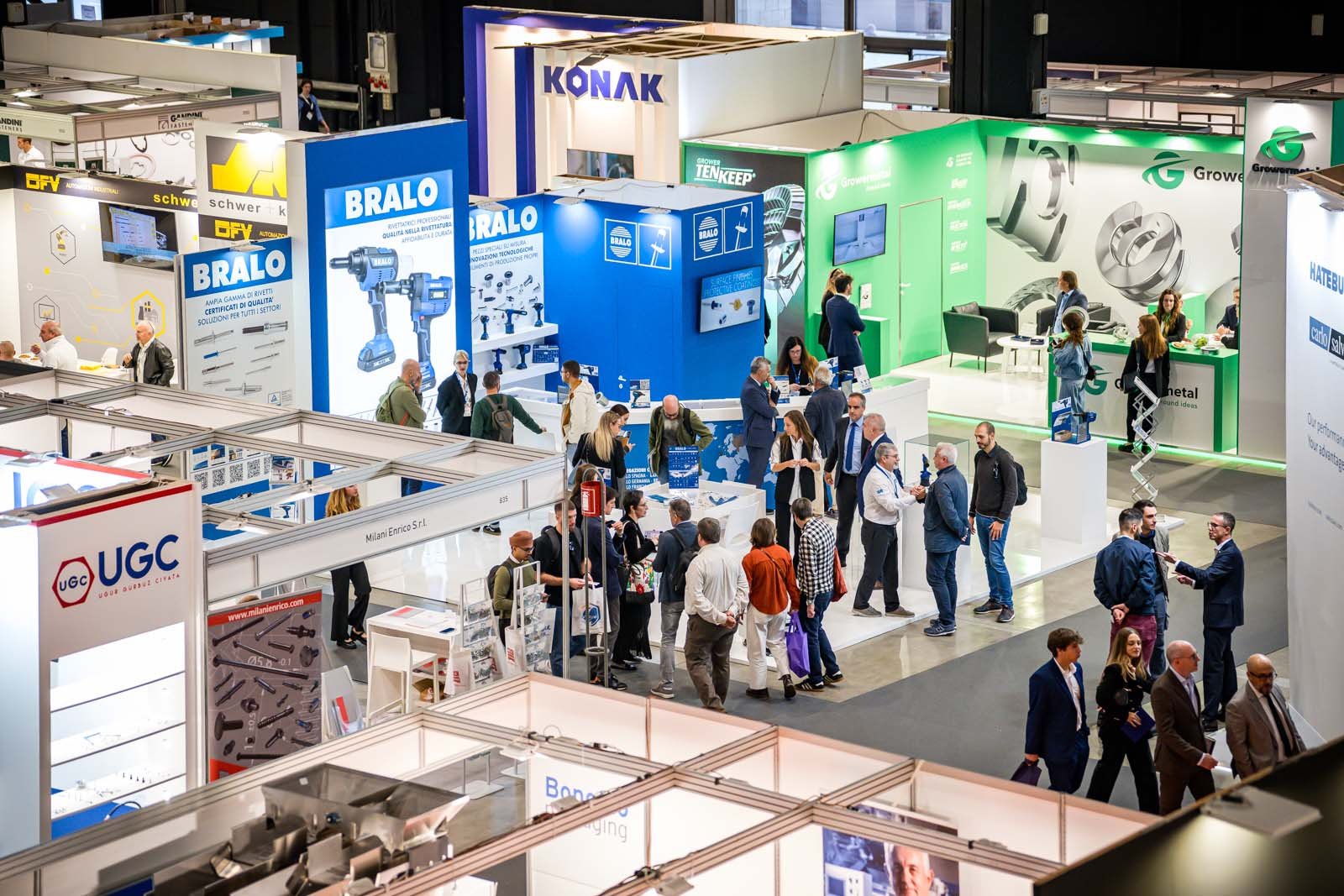
A strategic event to promote networking, innovation, and business development in the fastening systems market.
Fastener Fair Italy, the leading event in Italy for the fastener, bolt, and fixing systems industry, has announced a new schedule: the 5th edition will take place on June 24 and 25, 2026, at CityLife – Allianz MiCo in Milan, instead of the previous dates of October 6 and 7.
The decision stems from strong demand from international exhibitors and key industry stakeholders, with the aim of aligning the event with a more favorable trade fair calendar for the European market. Moving the event to the first half of the year is a strategic choice to facilitate logistical planning, enhance the visitor experience, and create new business opportunities before the summer break.
Steady Growth
This decision is also supported by the positive and growing trend of past editions: the most recent hosted over 200 exhibitors from 19 countries and attracted more than 2,400 qualified visitors from across Europe. The event saw intense networking and product presentation activity, accompanied by extremely positive feedback from the participating companies, reaffirming it as an essential showcase for the fastening systems market.
"The success of the last edition and the growing market interest have prompted us to advance the dates for the next edition, with the aim of making the event even more strategic and commercially effective," said Stephanie Cerri, Event Director of RX. "Placing it in the first half of the year allows us to seize an ideal window to foster long-term business relationships and launch new products. Thanks to a targeted networking program, visitors will be able to discover the industry's most innovative solutions and gain valuable insights into the latest technologies presented by leading players in the sector."
The fastener market plays a strategic role in numerous production sectors, such as automotive, aerospace, manufacturing, and construction, and in the Italian landscape, it is growing, also driven by the internationalization of markets, which represents a great opportunity for commercial expansion for the entire sector.
A look at the 2026 edition
The next edition of Fastener Fair Italy will introduce numerous innovations designed to offer an even more comprehensive and forward-looking experience for the industry. Among the planned initiatives are new thematic pavilions dedicated to innovation, sustainability, and hand tools, as well as an enhanced exhibition offering for turning companies and financial support measures for businesses.
The event will also aim to expand its international presence, attract new exhibitors from key markets, and enhance the quality of its visitors, with a particular focus on distributors, buyers, and technical decision-makers. There will also be networking activities, training content, and technical insights to further enrich the trade fair experience.
Fastener Fair Italy is part of a series of trade events organized by RX for the fastener, bolt, and fixing industry, including Fastener Fair Global, the Fastener Fair brand's flagship event held in Germany, Fastener Fair India, Fastener Fair Mexico, and Fastener Fair USA.
For more information, visit www.fastenerfairitaly.com.
Fastener Fair Italy is also on LinkedIn. Follow us to stay up to date on upcoming news!
Mechanical exports exceed 20 billion euros in the first half of the year
The figures presented at Anima Export Days 2026: +2.8% compared to the same period last year. Exports are growing in the USA, China, and Germany. Exports of the mechanical engineering sector represented by Anima Confindustria reached €20.4 billion in the first half of 2026, up 2.8% compared to the same period in 2025. The data, processed by Anima's Statistics Office based on Istat data, were presented during the Brescia leg of Anima Export Days , the initiative dedicated to the internationalization of the Italian mechanical engineering sector. Running from September 28th to October 1st, the event is bringing together companies in the sector with selected international buyers. Now in its sixth edition, the Export Days are a collaboration between Anima Confindustria, the Ministry of Foreign Affairs and International Cooperation (MAECI), and the Italian Trade Agency (ITA), with the aim of fostering new trade relations and supporting the strengthening of Italian companies' presence in foreign markets . This year, the B2B meetings involve operators from over 20 countries and are taking place in four locations : Borgosesia, Turin, Brescia, and Bassano del Grappa. The initiative comes at a time when geopolitical tensions and uncertainties over trade policies continue to impact international trade. Against this backdrop, data for the first half of 2026 paint a resilient picture for the mechanical engineering sector, represented by Anima. Exports from Anima's sectors totaled €20.4 billion , up 2.8% from €19.8 billion in the same period in 2025. The trend confirms the sector's strong international vocation , albeit with varying trends. The main export components include valves and faucets , gas turbines, hydraulic pumps, and air conditioning systems. Other sectors are showing positive results, while others are experiencing a decline. Geographically, the United States remains the leading destination market for exports in the animal and animal sectors, with €2.38 billion in the first six months of 2026, up 2.4% compared to the same period of the previous year. Germany follows, with €1.99 billion (+4.8%), and France, with €1.81 billion (+2.9%). Alongside the more established European markets, some particularly significant trends are emerging in non-EU areas, starting with China, the Middle East, and North Africa. Despite a general decline towards the Gulf countries (-3.7%), exports to Saudi Arabia grew by 14.6% (665.1 million euros) , supported by the sectors related to process plants, energy, infrastructure and cooling. In China , exports of the Anima sectors grew by 22.3% and reached almost 720 million euros . The aeraulic systems sector was the main driver of this increase. Steam turbines and air compressors also recorded good growth in China. Algeria's growth was even more significant, rising 146.7% from €173.3 million to €427.6 million. This result was primarily driven by technologies such as gas turbines (which account for approximately 47% of total exports to the country), valves and taps, as well as pressure products and equipment. These flows are often tied to individual orders and therefore not necessarily characterized by continuous trends, but the data highlights the ability of Italian companies to seize opportunities even in rapidly developing markets. "The 2.8% growth in exports in the first half of the year confirms the ability of Italian mechanical engineering to maintain a competitive position on international markets, even in a period characterized by geopolitical tensions and trade uncertainty. The United States remains the primary destination market, while the results in China and Algeria demonstrate the ability of companies to seize opportunities in different markets. This is a sign of resilience that must be accompanied by greater diversification and a strengthened international presence. In this regard, the Export Days represent a concrete tool for creating new relationships and business opportunities," stated Pietro Almici, president of Anima Confindustria . On the import front, in the first six months of the year, the Anima sectors recorded a 1.2% increase, for a total value of 9.73 billion euros; this figure completes the current trade picture and confirms the centrality now assumed by international markets beyond the European one. It is in this context that Anima is renewing its Export Days , transforming market analysis into a concrete opportunity for supply and demand to meet.

 Industriale.it certification