
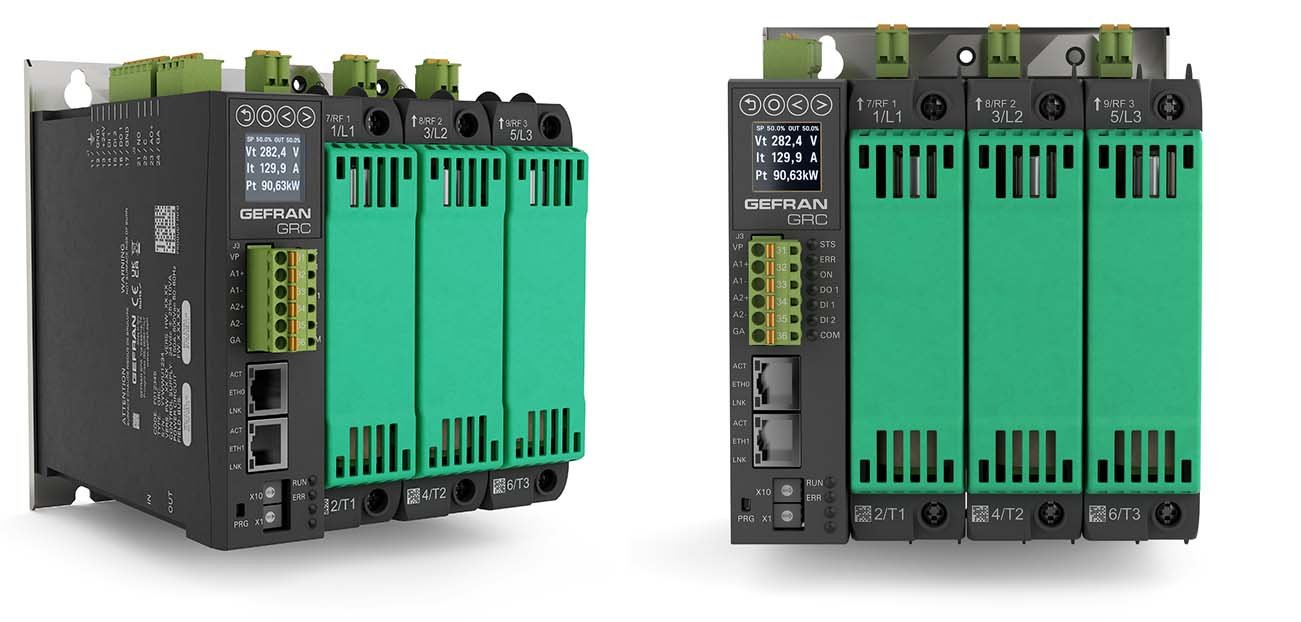
Maximum power, minimum footprint: Gefran presents GRC, the new intelligent power controllers for industrial electric heating.

Veröffentlichte die 23/10/2025
Maximum power, minimum footprint: Gefran presents GRC, the new intelligent power controllers for industrial electric heating.

Heat treatment is crucial in numerous industrial sectors, from glass to metals, from semiconductors to photovoltaic panels. These processes require careful management of temperature zones, through precise control of the current and power of the electric heating elements. The increasing digitalization of systems, driven by Industry 4.0, also requires devices capable of rapidly communicating with higher-level automation systems.

In response to these needs, Gefran presents GRC, the new series of intelligent and compact power controllers. Designed to offer high performance in industrial electric heating, they combine power, precision, and advanced connectivity via the main communication protocols.

GRC introduces new standards of scalability in the control of electric heaters. The series is modular and available in single-, two-, and three-phase configurations, with currents from 25 A to 150 A, thus adapting to linear and non-linear resistive loads for high temperatures. The compact size, combined with integrated fuses, allows for optimizing space in electrical panels, facilitating the design of more compact systems. Accurate current and voltage readings are another strong point. Thanks to integrated feedback algorithms, GRCs maintain stable power and current even in the presence of electrical disturbances, essential in critical processes such as semiconductor production or flat glass treatment.

Advanced connectivity completes the features of the series. All devices are native Ethernet and offer two physical ports for immediate access to data, without the need for additional cards or gateways. The integrated WebServer allows complete control of diagnostics and alarms through easy browser access from any device and remotely. Furthermore, the front LCD display allows for real-time monitoring of system performance, allowing timely intervention in the event of anomalies and optimizing operational continuity.

With the dedicated Gefran GF_eXpress software, installation, configuration, and maintenance are even faster and more intuitive. Thanks to a smart interface, designed to guarantee intuitive diagnostics and support efficient and customizable production processes.

"With GRC, Gefran's GRx platform is enriched with compact and functional devices, designed to meet complex application needs. The expansion of the available current range, already envisioned in the launch roadmap, demonstrates Gefran's commitment to creating flexible and scalable solutions," states Guido Zini, Power Controllers & SSR Product Manager at Gefran. "Innovation continues: with the expansion of the range scheduled for February 2026, advanced features in terms of digitalization, efficiency, and sustainability will be introduced."
Weitere Informationen: Gefran

Weitere Artikel, die Sie interessieren könnten

New range of chain tensioners from norelem

Three sizes, maximum flexibility, precise tensioningWith multiple sizes and clamping force options, robust materials, assembly aids, and retensioning options, the new range of chain tensioners from norelem effectively meets virtually every requirement in mechanical engineering, from confined installation spaces to highly stressed chain applications. Chain tensioners are used in a wide variety of machines and systems. Their main function is to compensate for the progressive elongation of the chain due to wear and tear, ensuring constant tension. This increases the service life and reliability of the chain drive. The norelem chain tensioners operate in an oscillating, elastic manner: this prevents excessive surface pressure, while the overall force resulting from the weight of the chain and the centrifugal force in the free chain run is optimally controlled. Installation is simple and ideally performed immediately behind the drive wheel to keep the free chain run as short as possible. The chain tensioner housing is made of plastic or steel; stainless steel versions are also available for more demanding requirements. The sliding profiles are made of ultra-high molecular weight polyethylene PE-UHMW. Norelem offers solutions for every clamping requirementThe robust size TS is supplied as standard with a plastic-coated, galvanized steel housing, with a choice of curved or elliptical profile. The clamping system is equipped with two preloaded compression springs. These springs can be released individually to achieve three levels of clamping force:Only right spring released: High clamping forceOnly left spring released: Low clamping forceBoth springs released: Extra clamping force The compact size 0 is available in two versions with different clamping forces: low spring force (58-32 N) and high spring force (132-60 N). The compact design makes this tensioning system the ideal solution for installations in confined spaces, and thanks to its plastic housing, it is completely corrosion-free. The versatile size 1 chain tensioners are available in two versions with different tensioning forces and in two shapes: low spring force (174-32 N), high spring force (396-60 N), shape A (short housing), and shape B (long housing).Extras include a color scale for a quick visual check of the chain tension, and various fixing brackets and slotted holes for easy adjustment and compensation for alignment errors. 

06/11/2025 Mehr lesen

Introduction of a best-selling profiling tool and other new features for cutting

High-precision profiling geometry -RO now available in CoroCut® 2Sandvik Coromant, a global leader in metal-cutting tools and related solutions, has introduced four optimized insert geometries within its high-performance parting and grooving concept, CoroCut® 2. The launch includes the ground profiling geometry -RO for nickel-based HRSA, in addition to the three updated parting geometries -CF, -CS and -CR. These additions translate into benefits such as reduced burr and pin formation and improved edge line quality.CoroCut® 2 stands for quality, efficiency and process security across a wide range of applications, helping shops increase productivity, optimize energy consumption and reduce material waste. The latest development in the range makes the offering even more complete, with dedicated geometries for profiling in challenging materials and parting-off operations that require greater reliability and productivity.The ground profiling geometry -RO, ideal for finishing operations in nickel-based HRSA superalloys, has been updated and included in the CoroCut® 2 range. New grades and a stabilizing rail interface improve wear resistance and dimensional accuracy, enabling close tolerances and consistent surface quality. "The -RO geometry has long been the most popular insert geometry in the CoroCut® 1-2 concept, thanks to its sharp cutting edge, close tolerances and high edge line quality, all of which are crucial for the production of complex components in the aerospace segment," says Jenny Claus, Product Manager Parting and Grooving at Sandvik Coromant.Additionally, the range includes three newly added or optimized parting geometries:-CF geometry: Light-cutting, positive geometry updated with CoroCut® 2 grades and patented Flashlight technology, offering low cutting forces and superior edge line quality cutting edgeCS-Geometry: Ground geometry with a sharp front angle and cutting edge to minimize burr and pin formation, now with a rail interface for increased stabilityCR-Geometry: Versatile geometry with a new front angle that reduces burr and pin formation in a wide range of materials, ideal for operations where strong, durable cutting edges are required"CoroCut® 2 inserts stand out thanks to the benefits of our Flashlight technology, rail interface and high-performance grades," says Fredrik Selin, Product Application Specialist at Sandvik Coromant. "No matter what the parting or grooving challenge, these features ensure excellent chip control, long tool life and high stability, even at high speeds and feeds."The CoroCut® 2 range includes tools and inserts for parting, internal and external grooving, face grooving and profiling operations, from roughing to finishing. Designed for use with double-edged inserts in all materials and ISO applications, it is a versatile, sustainable and cost-effective tooling solution to meet the demanding requirements of modern manufacturing.Learn more about CoroCut® 2 on the Sandvik Coromant website. Sandvik CoromantTogether with customers and partners, Sandvik Coromant is leading the way towards a sustainable future and providing tooling solutions to mechanical engineering industries worldwide. Over eighty years of practical experience have allowed us to accumulate a wealth of knowledge in metal cutting and processing. These skills transform every challenge into an opportunity for innovation, collaboration, and cutting-edge solutions. Our goal is to pursue positive change by promoting sustainability, efficiency, and growth to shape a future where innovation takes center stage. Part of the global industrial engineering group Sandvik, Sandvik Coromant is committed to building the future, together with its customers. For more information, visit www.sandvik.coromant.com or follow us on social media.

05/11/2025 Mehr lesen

Industrial annealing furnace: what it is and what it's used for

When we talk about industrial furnaces, we tend to think of a single category of machinery, but in reality there are numerous types, each designed to meet specific processing needs. A key example is the annealing (or solution-heating) furnace, widely used in companies in the metalworking sector.What is an industrial annealing furnace?The annealing furnace is a machine designed for the heat treatment of metals, particularly austenitic stainless steels, known for their excellent mechanical properties and resistance to corrosion.The process involves:1. Heating the metal to a high temperature.2. Maintaining the temperature for a predetermined time.3. Rapid cooling, usually by air or water.Thanks to this cycle, the treated metals improve their characteristics, acquiring:•    greater resistance at both room and elevated temperatures,•    improved corrosion resistance,•    maximum resistance to oxidation.Types of Annealing FurnacesThere are different configurations of annealing furnaces, which vary according to the type of production:•    Continuous furnaces: equipped with conveyor systems using belts made of high-strength alloys or rollers (also made of ceramic, for high-temperature processing with greater energy efficiency).•    Batch Furnaces : Ideal for non-continuous production or for specific components such as fittings, sinks, pipes, or turbine blades.This variety allows us to meet the needs of various sectors: automotive, metallurgy, design, and special processes.Other Heat Treatment FurnacesIn addition to annealing furnaces, the sector offers many other solutions:•    brazing furnaces,•    sintering furnaces,•    tempering furnaces,•    Reheating furnaces for forging.Each has specific characteristics and fields of application, making expert support essential when choosing.SABE Forni: Consulting and Customized SolutionsIn such a diverse landscape, relying on a qualified partner is the key to obtaining the industrial furnace best suited to your needs.Sabe Forni is an international benchmark in the design and construction of custom industrial furnaces. In addition to sales, the Treviso-based company offers a specialized consulting service to guide companies in choosing the most suitable machinery, ensuring efficiency, quality, and reliability.

05/11/2025 Mehr lesen

Abonnieren Sie unseren Newsletter
Um über die neuesten Nachrichten der Industriewelt auf dem Laufenden zu bleiben

Kontaktieren Sie uns
Image Newsletter Lindustriale

L'industriale srl 2025 - Alle Rechte vorbehalten
Datenschutzerklärung - Cookies

Top
This website is protected by reCAPTCHA, therefore the Google privacy policy and terms of service apply.